
 English
expand_more
English
expand_more
 Español
 Deutsch
 Français
 Português
 Türkçe
 Polski
 العربية
 हिन्दी
Brand Visibility in LLMs
Have you ever checked what different neural networks actually say about your company? The same brand can be described one way by ChatGPT, another way by DeepSeek, and yet a third way by Perplexity – and sometimes these descriptions diverge significantly from reality. Our Brand Visibility in LLMs Report helps you see exactly that, so you can understand where to focus your efforts to ensure AI assistants correctly identify and describe your website.
What This Report Reveals
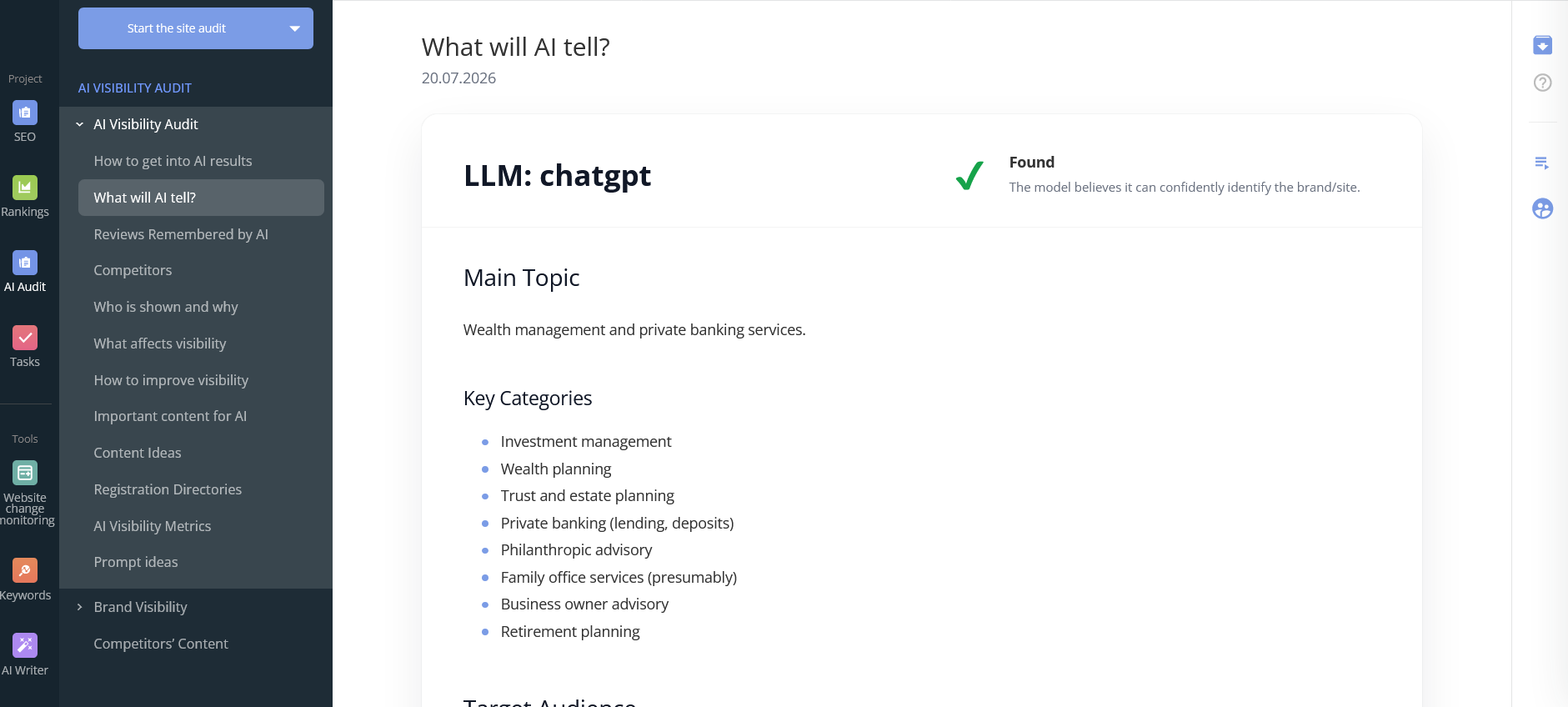
The report gathers responses from several popular AI systems – including ChatGPT, DeepSeek, Perplexity, Gemini, Claude, and a manual reference mode – when asked about your brand or website. You will see:
- Whether each model confidently recognises your brand, hesitates, or fails to find it at all.
- What description (topic, audience, geography, key products/services) each LLM generates.
- How well those descriptions match your actual positioning and reality.
This is not just a “test of attentiveness” – it is a practical SEO and marketing tool that reveals gaps in your brand’s visibility for the new generation of search: AI-powered search and generative answers.
Why This Report Is Both Valuable and Actionable
Traditional SEO analytics track rankings in search results but tell you almost nothing about how neural networks perceive your site. Yet more and more users are receiving answers from assistants like ChatGPT with web search, Perplexity, Google’s AI Overviews, and similar tools. If your brand is not included in their responses or is described inaccurately, you are losing traffic and customers.
Our report provides concrete growth points:
- Identifies “blind spots” – where AI does not recognise your brand or hallucinates based on sparse data.
- Compares different models – so you can see which systems are stronger for your visibility and which are weaker (e.g., DeepSeek may be confident while Gemini is not).
- Helps explain why answers differ – due to each model’s underlying approach (pure memory, real-time search, or selective web access).
- Provides a practical action plan – exactly what to improve on your site so that AI begins to cite your brand accurately.
Who Benefits Most From This Report
- SEO specialists and marketers who want to adapt their strategy for the era of generative search.
- Business owners and brand managers who care that their company is correctly represented by both people and algorithms.
- Agencies offering full-service SEO and reputation management – to justify the need for AI visibility work to their clients.
- Websites whose actual descriptions in LLMs diverge from reality – for instance, AI invents competitors, wrong geography, or product lists.
Interpreting the Results – From Hallucinations to Reality
If you find that one or more models describe your brand incorrectly, incompletely, or not at all – do not panic. This is a signal that your site and external mentions are not providing sufficiently strong and verifiable signals for AI. When data is lacking, language models tend to “fill in the gaps” using general templates or indirect sources. The goal is not to complain to the LLM developer, but to strengthen your own digital infrastructure.
The report clarifies what each model relies on:
- DeepSeek and “pure” Gemini (non-web) – depend on training data. For them to know you, you need persistent mentions in public sources (directories, news, reviews, social media) and strong SEO signals that boost authority.
- Perplexity, Google AI Overviews, and other web‑connected assistants – perform real‑time internet searches at query time. To appear in their answers, you must have: proper indexing, crawlable pages, quality content aligned with intent, and structured data (lists, tables, FAQ).
- ChatGPT and Claude (with web search) – may enable web search selectively. Your chances increase if the user explicitly asks for a site analysis (with the URL) and your pages are open to bots.
- Manual reference mode – this is the baseline, filled in by you or based on verified data. Comparing it with automated responses reveals the gap.
What to Do So That AI Describes Your Brand Correctly
Based on the analysis from our report, we have prepared a short action plan (a full checklist is available in the separate guide “How to Appear in AI Answers”):
- Check SEO accessibility: all important pages must be indexable, not blocked from crawling, and return correct status codes (200) and canonical tags.
- Add clear, structured statements about your brand: who you are, where you operate, what products/services you offer, and for whom. Place these in texts, lists, tables, and FAQ sections.
- Increase the number of external, citable mentions in directories, industry portals, news, and reviews. AI models trust sources that are “visible” to search engines.
- Use Schema.org markup (Organization, LocalBusiness, Product) – this helps models unambiguously determine the type and attributes of your business.
- Monitor tone and content uniqueness: avoid vague phrasing; add specific numbers, dates, and facts.
Why Answers for the Same Brand Can Vary From Query to Query
This is completely normal. Generative systems are probabilistic – they can change wording, emphasis, and even examples. Additionally, the context of the dialogue, the freshness of the index, and whether the assistant decided to use search at that moment all affect the output. Therefore, our report evaluates not a single answer, but consistent patterns: recurring errors, stable gaps, and typical sources. This provides an objective picture for improvements.
When AI Should Analyse Your Site – and When It Should Not
The report also helps you understand whether you are requesting analysis correctly. An AI assistant should logically run a page check when both of these conditions are met:
- The user wants a result tied to a specific website (“Review the content on example.com”).
- The query includes the domain/URL, sitemap, or a data dump.
- The site is technically accessible (no login required, no bot blocking).
If you simply ask “What SEO factors matter?” or “What is E-E-A-T?” – the AI will give general advice without analysing your site. That is correct behaviour. The report helps you avoid expecting the impossible from assistants and know when they should actually reference your resource.
Conclusion
The Brand Visibility in LLMs Report is not a one‑time check but a working tool for strengthening your business resilience in the age of generative search. By regularly tracking how LLMs describe your site, you can spot distortions early, reinforce the right signals, and ultimately receive accurate, customer‑attracting answers in ChatGPT, Perplexity, AI Overviews, and other systems.
Use the insights from this report together with our full guide “How to Appear in AI Answers” to step‑by‑step bring your website to ideal visibility.
Ready to see how AI perceives your brand? Get your personalised report today and turn AI narratives into your competitive advantage.
Download the full checklist and strategy guide inside the report.