
 English
expand_more
English
expand_more
 Español
 Deutsch
 Français
 Português
 Türkçe
 Polski
 العربية
 हिन्दी
Content Ideas
Artificial intelligence is fundamentally reshaping search engine optimisation. Traditional SEO methods no longer apply in the same way when it comes to recommendations from ChatGPT, Perplexity AI, Gemini, and other neural networks. This report — “Content Ideas for Better AI Visibility” — is a practical guide designed to help you build a systematic content approach for AI-driven channels. In this article, we break down what the report contains, why each section is critical, and who will benefit from it most.
What’s Inside the Report: Structure and Core Modules
The report is composed of 11 thematic sections, each tackling a specific objective — from idea generation to technical optimisation for AI search. Below is a detailed walkthrough of every block.
1. 20 Content Types That Drive AI Traffic
This section lists the formats most frequently preferred by neural networks: guides, comparisons, case studies, knowledge bases, FAQ articles, evergreen content, and more. Instead of generic advice, you get concrete examples with explanations of why each format works. It also discusses the priority of usefulness over volume — how concise, punchy answers outperform lengthy texts.
Why it matters: AI models are trained on structured, authoritative, and relevant data. By knowing which formats are favoured, you can steer your editorial team toward the genres that are actually cited by neural networks.
2. Prompts for AI Recommendations
A ready-made set of phrases to interact with ChatGPT and other assistants. Examples include: “what content works in ChatGPT”, “article ideas for AI SEO”, “what to write to get AI traffic”. It also recommends combining prompts with your brand name or domain — this helps AI associate content with your specific site.
Why it matters: Prompts are the bridge between your content and AI search results. A well-crafted query can highlight your expertise to the neural network.
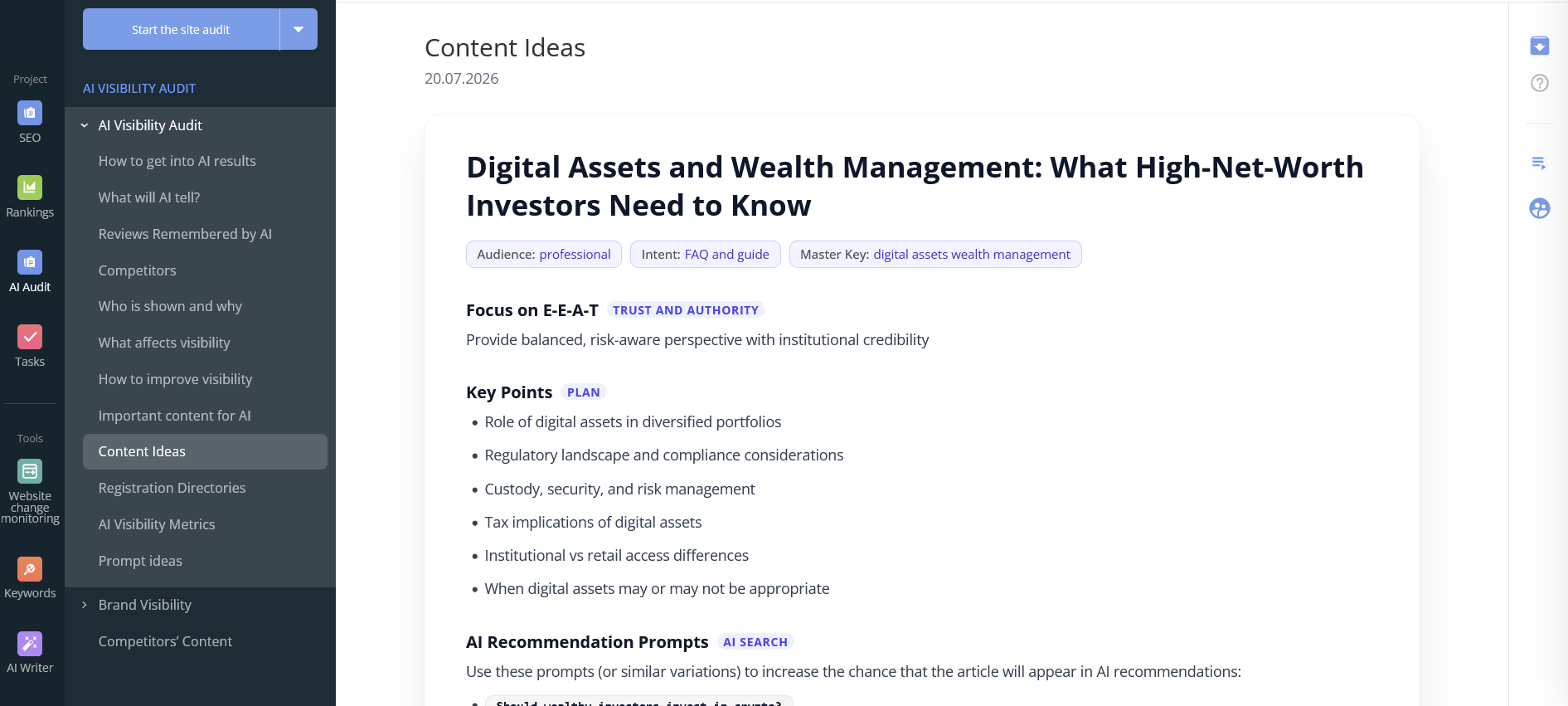
3. Target Keywords (Core Queries)
For each topic, the report provides a semantic core: “content ideas”, “AI traffic”, “content strategy”, “AI SEO vs SEO”, “future of search”, “competitor analysis”, and others. These keywords are recommended for on‑page optimisation.
Why you need this: Classic search (Google) remains an important channel. Optimising for these queries attracts organic traffic, which can also be used by AI models during training.
4. Comparative Overview: AI SEO vs Classic SEO (What Actually Works in 2026)
An analysis of the differences between ranking in traditional search engines and the logic of AI recommendations. Key takeaways: the declining role of backlinks, growing importance of context and brand mentions, and the shift from “content for traffic” to “content as a source of answers”. It also offers tips on adapting old SEO articles for AI.
Why this matters for marketers: It allows you to reallocate budgets — not chasing outdated metrics (e.g., number of referring domains) but focusing on semantic coherence and authority.
5. Analytics: The Future of Search – How AI Will Change Marketing in 3 Years
A forward-looking section for leaders and strategists. Trends covered: declining role of classic search engines, growth of conversational search, changing user behaviour, and new traffic channels. Recommendations on what businesses should do now.
Value: Helps you build a long‑term strategy, stay ahead of competitors, and invest in areas that will pay off in 1‑2 years.
6. Guide: How to Analyse Competitors in the AI Era
Explains why classic analysis (positions in SERPs, backlinks, keyword density) is outdated. Instead, methods for evaluating competitors’ AI visibility — which fragments of their content are cited by neural networks, what metrics to track, which tools to use. Emphasis on finding content opportunities.
For whom: Marketers and analysts who want a real market picture, not just Google rankings.
7. How‑to: Write FAQ Content That AI Chooses for Answers
FAQ is recognised as a key format for AI. This section teaches you how to phrase questions (the way real people ask them), determine the optimal answer length (usually 2‑3 sentences plus expansion as needed), and avoid typical mistakes. Underlines the importance of natural language.
Significance: Most voice queries and short AI answers are built on FAQ structures. Without them, your chances of being cited drop sharply.
8. Complete Guide to AI Visibility: How to Get into ChatGPT and Other AI Recommendations
The most comprehensive section. It reveals principles behind how neural networks generate responses, the priority of trusted domains, the role of structured data (schemas, lists, tables). Explains why expertise and authorship matter more than classic SEO, and how to write articles that AI “understands” at a semantic level. Real‑world mistakes of sites that fail to get AI recommendations are also shared.
Who needs it: Business owners and mid‑level marketers who want a systematic approach rather than one‑off tactics.
9. E‑E‑A‑T in the Age of Neural Networks: How to Become an Authoritative Source
A breakdown of the E‑E‑A‑T principles (Experience, Expertise, Authoritativeness, Trustworthiness) as they apply to AI. How AI determines trust, why the author’s personal brand affects citation, how to build digital authority through mentions and backlinks (of the new type). Lists errors that reduce trust.
Why this is a core section: Neural networks are getting better at filtering out content created “just for traffic”. If your site doesn’t prove its expertise, it will be ignored even with perfect traditional SEO.
10. Case Study: How to Increase AI Traffic by 5× in 3 Months
A real‑world example with numbers. Describes the starting situation (low visibility in ChatGPT), what changes were implemented (content structure, formats, E‑E‑A‑T work), and the AI‑focused content strategy. Results are shown with metrics (mentions, visits, share of voice) and final conclusions.
Value of the case study: It proves the methodology works in practice, not just in theory. Gives you a basis for planning your own experiments.
11. Content That Neural Networks Cite: Structure of the Perfect Article + Marketing Prompts
Two combined blocks. The first covers article architecture for AI parsing: clear answers, logical sections, use of subheadings, bulleted lists, definitions. The second provides a bank of ready‑made prompts for ChatGPT — for competitor analysis, content creation, and marketing automation. Also includes tips on adapting prompts to your specific business.
Final importance: Gives you immediate action tools. You can take a prompt and apply it today, and copy the article structure for your content plan.
Why This Report Is Critically Important for Business in 2026
AI search is no longer an experiment. According to the report’s data, up to 40% of users now turn to ChatGPT or similar tools instead of classic search engines at least occasionally. At the same time:
- Traditional SEO is losing effectiveness: link weight and over‑optimised texts do not work for neural networks.
- AI favours sites with clear structure, authoritative authors, and practical experience (E‑E‑A‑T).
- Without adapting content for AI, you are losing a growing traffic channel that your competitors are already capturing.
This guide provides not just theory but a step‑by‑step plan: which formats to launch, which keywords to optimise for, how to restructure editing processes, and how to measure results.
Who Needs This Report First and Foremost
Website Owners and Commercial Project Leaders
You’ll gain an understanding of where traffic is going and how to win it back through AI channels. The report helps you decide: should you change your content strategy, hire expert authors, or implement structured data?
Marketers and Marketing Heads
A ready‑made checklist for assigning tasks to your team: which topics to choose, how to rewrite FAQs, which prompts to use for quick wins. You’ll also get arguments to defend your budget with leadership.
SEO Specialists
You’ll learn how to combine traditional optimisation with the new requirements of AI. The report offers metrics for reporting, competitor analysis methods, and examples of successful case studies you can replicate.
Content Managers and Copywriters
You get concrete article templates, rules for phrasing FAQ questions, examples of evergreen content, and ready‑made prompts for ChatGPT to speed up your workflow. This increases your value as a specialist.
Strategists and Digital Agency Owners
The analytical section on the future of search allows you to offer clients modern AI promotion services, stand out from competitors, and build long‑term strategies for 2‑3 years ahead.
How to Use the Report in Practice: A Quick Action Plan
- Study the “20 Content Types” section — select 3‑5 formats that suit your niche.
- Take the AI prompts and test how ChatGPT describes your brand and competitors.
- Check your current content against E‑E‑A‑T criteria (Section 9) — add authorship, research references, and case studies.
- Adapt at least one old article following the “AI SEO vs Classic SEO” guide (Section 4).
- Implement FAQ blocks using the rules from Section 7 on 3‑5 key pages.
- After one month, measure the change in AI mentions (tools are suggested in the competitive analysis section).
Conclusion
This report — “Content Ideas for Better AI Visibility” — is your navigation system in a world where search is giving way to conversational AI systems. It combines:
- a holistic view (from formats to metrics),
- practical applicability (ready‑made prompts, checklists, examples),
- a focus on trust and authority (E‑E‑A‑T as the foundation).
Implementing the recommendations does not require a revolution — just a consistent shift in your content approach, starting with FAQs and article structure. Those who start now will gain a 12‑18 month advantage, when AI search becomes mainstream across most industries.
Ready to take action? Use this report as a workbook: mark off completed items, test the prompts, and record your results. This guide is backed by current 2026 data, so you can rely on it in your daily work.