
 English
expand_more
English
expand_more
 Español
 Deutsch
 Français
 Português
 Türkçe
 Polski
 العربية
 हिन्दी
Who Gets Shown & Why
Inside our platform, a dedicated report—called “Who Gets Shown & Why”—exists to dissect how and why AI‑driven recommendation systems (including ChatGPT and its peers) select particular websites in response to user queries. Unlike conventional SEO dashboards, this report doesn’t stop at technical metrics; it dives into behavioural and semantic patterns that generative models actually rely on.
The report’s standout feature is its strict appetite for high‑quality input. If there isn’t enough reliable data about a site, the system flags that gap and refuses to produce shallow or speculative predictions. Below, we break down exactly what data matters, why the report is valuable even when data is scarce, and who benefits most from it.
What Data Drives the “Who Gets Shown & Why” Report
To accurately determine which queries make an AI recommend your site, which competitors are in the race, and which factors tip the scales, the following information is essential. Our analysis engine builds on these precise parameters:
- Site vertical – the core industry (construction, legal, healthcare, marketing, e‑commerce, etc.).
- Products or services offered – the concrete value you provide to users.
- Geographic scope – local (city, region), national, or international market.
- Key pages on your site – service sections, blog, case studies, portfolio, contact info.
- Main competitors – if known, our system can compare signals and positioning.
- Brand positioning – premium, mass‑market, niche expert, innovation leader, etc.
Without these pieces, the algorithm cannot define relevant semantics, map the competitive landscape, or spot your strengths and weaknesses in the context of AI recommendations. So a report that says “insufficient data” isn’t a bug—it’s a built‑in quality filter that saves you from guesswork.
Why the Report Is Valuable Even When Data Is Lacking
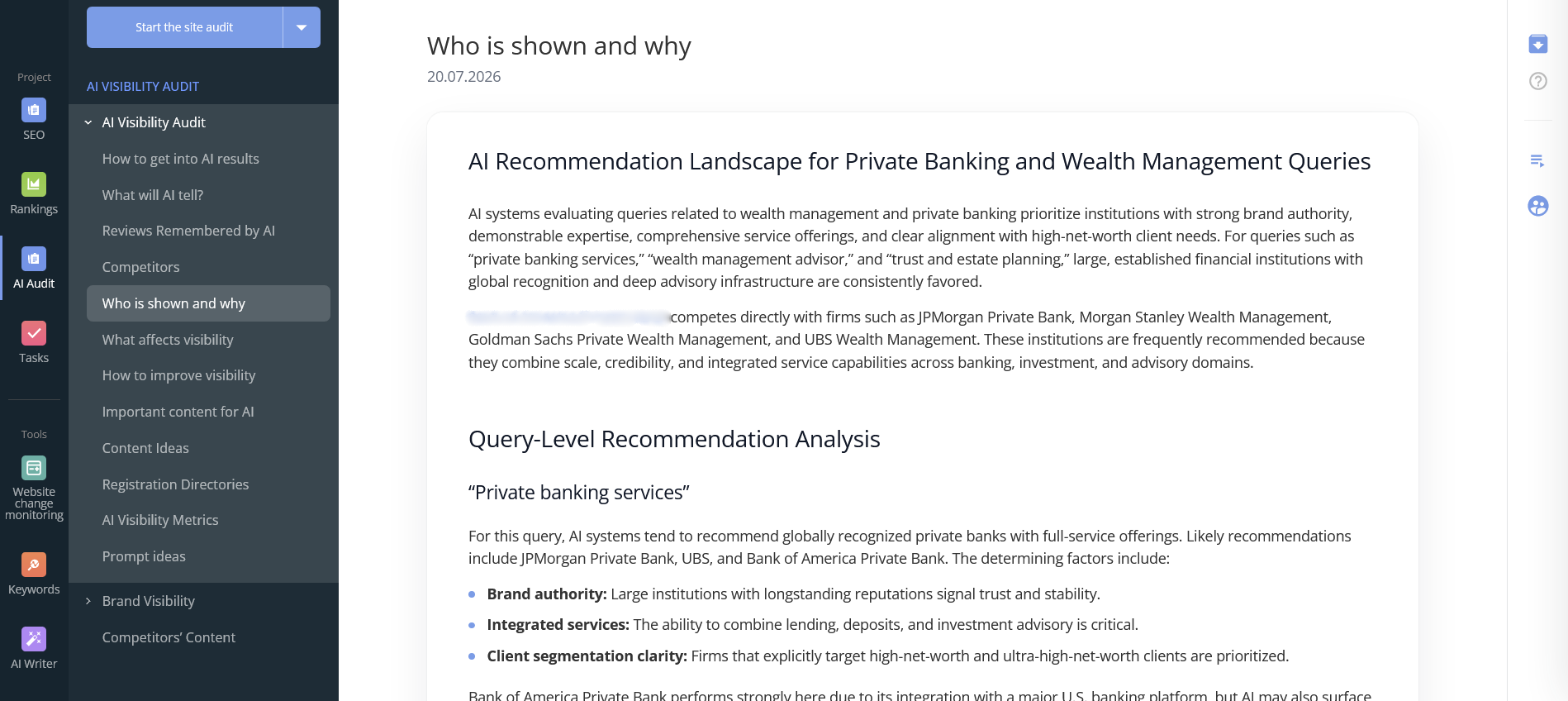
Many users expect ready‑made answers, but the real worth of this report lies in its diagnostic honesty. Here are its key benefits:
- Transparent gap analysis – you get a clear checklist of missing information, not vague guesses. This saves time and lets you refine your company profile with purpose.
- Teaches the principles of AI ranking – the report explains which factors genuinely influence appearance in neural‑network outputs: content relevance, material authority, site structure, external brand mentions, and clarity of positioning.
- Prevents wasteful strategies – instead of generic “improve your SEO” advice, you see concrete reasons why analysis is impossible. This protects your budget from ineffective channels.
- Diagnoses the “AI hallucination” problem – if chatbots describe your brand inaccurately or invent details, the report points out that weak signals (closed pages, low online “weight”) force AI to fill in the blanks. That’s a direct nudge to boost authority and transparency.
- Delivers an actionable roadmap – even the “insufficient data” message comes with a recommendation: provide a detailed company description or grant access to your site structure. After that, we prepare a full competitive breakdown, search scenario analysis, and a visibility enhancement strategy.
Thus, “Who Gets Shown & Why” becomes a navigational chart—from gathering raw information to concrete tactical moves.
Who Benefits Most from This Report
This analytical tool delivers tangible value across different business and marketing roles:
Business Owners & CEOs
You see objective barriers preventing your brand from appearing in AI assistant responses. Instead of emotional complaints like “ChatGPT never shows us,” you get a structured conclusion: geography missing, service list unclear, or competitors undefined. That’s a management‑friendly guide to give precise tasks to your marketing team.
SEO Specialists & Digital Heads
The report provides a ready‑made pre‑project checklist. You can immediately ask clients for missing data (vertical, page list, competitors) instead of spending weeks on hypotheses. It also helps you justify to clients why positioning and expert content matter for AI visibility.
Marketers in Charge of Content & Reputation
The tool explains why some sites get AI recommendations while others don’t—even with good technical scores. You get concrete criteria: produce content that demonstrates expertise (case studies, research, industry articles), secure brand mentions on authoritative platforms, and ensure a transparent site architecture. This backs up your pitch for expanding content plans and PR activities.
Companies Facing Inaccurate AI Descriptions
If ChatGPT or another assistant spits out irrelevant or fabricated facts about your business, “Who Gets Shown & Why” helps you trace the root cause: the AI lacks verifiable signals. The fix is to work on establishing your brand as a recognised “entity”—which includes publishing structured information, indexing key pages, and building external authority.
How to Apply the Report’s Findings in Practice
If you receive a report with the “insufficient initial data” flag, follow these steps:
- Gather the missing information from the section “What Data Drives the Report” (vertical, services, geography, competitors, positioning).
- Make sure this data is reflected on your site: create or update pages like “About Us,” “Services,” “Case Studies,” and clearly indicate your service areas.
- Check that crucial sections aren’t blocked from indexing (robots.txt, noindex meta tags).
- Submit the collected description through our data‑enrichment form (available when you re‑run the report).
- In parallel, boost brand awareness: publish expert articles on industry portals, earn backlinks from reputable sources, take part in podcasts or interviews.
After that, a second run of “Who Gets Shown & Why” will produce a full‑fledged analysis: specific search scenarios, a list of likely AI‑recommended competitors, reasons for your current inclusion (or exclusion), and a step‑by‑step visibility strategy.
Conclusion
The “Who Gets Shown & Why” report is far more than an answer generator—it’s an intelligent tool that first validates the quality of your input data. If information is insufficient, it frankly says so, educating you about the critical parameters of analysis. That benefit reaches website owners, SEOs, and marketers alike: it saves budgets, gives clear directions for content and positioning improvements, and helps you build a strategy so your brand becomes a recognisable “entity” for AI systems.
Use this report as a launchpad. The richer and more accurate your business profile, the more actionable and precise your recommendations will be for appearing in ChatGPT and other generative model outputs.
Ready to stop guessing? Run the diagnostic today and turn AI uncertainty into a competitive advantage.