
 English
expand_more
English
expand_more
 Español
 Deutsch
 Français
 Português
 Türkçe
 Polski
 العربية
 हिन्दी
The Ultimate Guide to Reputation Reports
Collecting and processing customer feedback has long ceased to be a simple exercise in “reading opinions.” In a landscape marked by fierce competition and digital transparency, a systematic, analytical approach is what truly makes the difference. That is why a report built on a deep dive into feedback becomes a strategic asset. In this article, we explore why a high-quality reputation report is invaluable, what information it reveals, and who should pay close attention to it.
Report Structure: More Than Just “Good” or “Bad”
A typical reputation report includes several essential building blocks that paint a complete picture of your brand’s perception. The first and most obvious section is your strengths. Unlike scattered positive comments, an analytical report groups praise into concrete categories: professionalism, timeliness, marketing effectiveness, creativity, and reliability. This grouping helps you understand exactly where you outperform the market and which qualities you can highlight in your marketing efforts.
The second critical block covers weak points and growth areas. At first glance, if most reviews are positive, you might think weaknesses don’t exist. However, a professional report uncovers latent issues: a lack of independent reviews, an overrepresentation of corporate thank-you letters, an absence of user (B2C) criticism, repetitive boilerplate phrasing, or even silence about unsuccessful projects. These are all signals that demand attention.
The third block is a map of platforms where your company is mentioned—or conspicuously absent. Knowing specific sites (from Google Maps and Apple Maps to professional directories like Clutch.co and GoodFirms) enables you to build a systematic reputation management strategy: claim your profiles, encourage honest reviews, and monitor new mentions in real time.
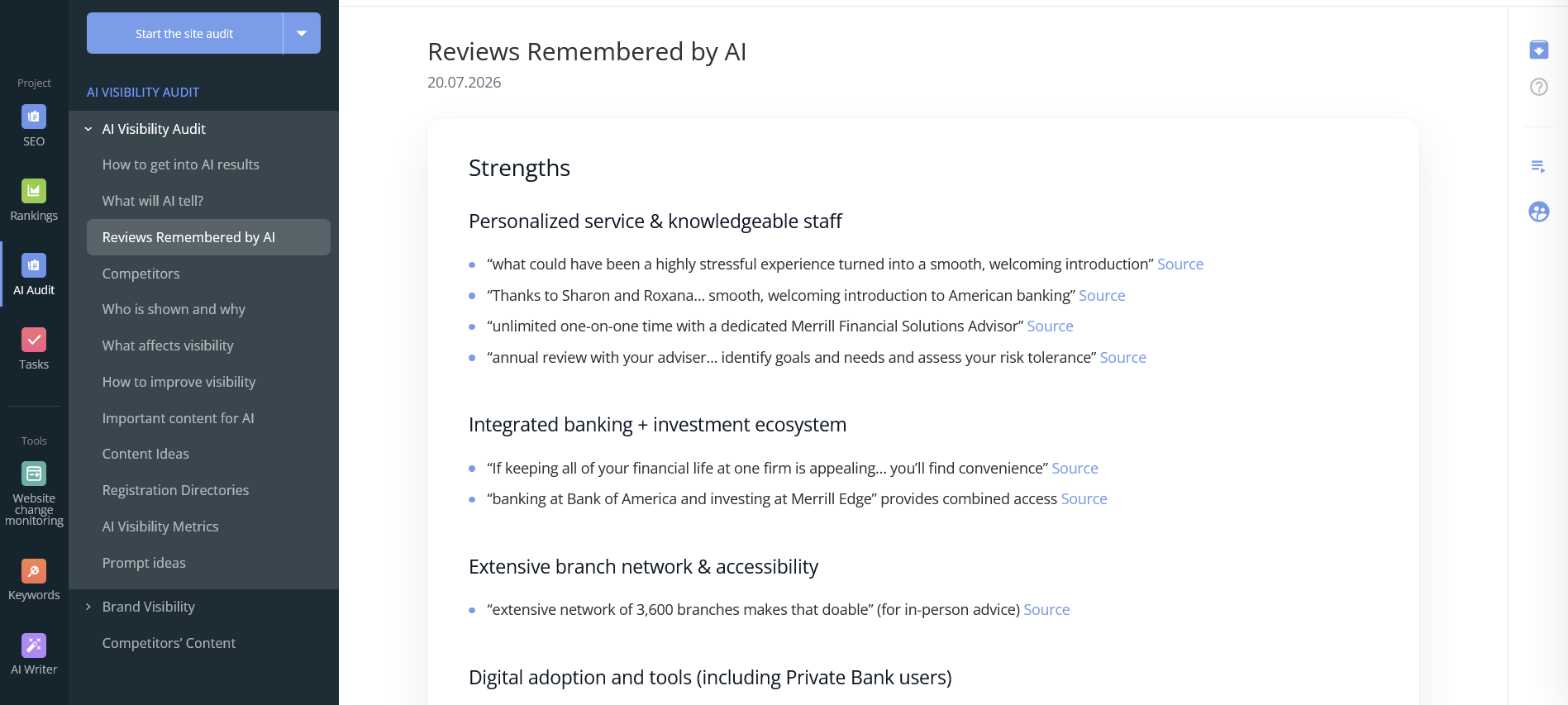
Example of a comprehensive reputation analytics dashboard
What Valuable Information Lies Hidden in Review Analytics?
A well-crafted report answers questions that rarely surface in casual browsing:
- Does the company truly meet deadlines? – If the phrase “works quickly” appears in every third review, that is not just a compliment but a consistent trend you can use as a unique selling proposition (USP).
- Are there measurable, tangible results? – Mentions of increased traffic, lead volume, or improved search rankings confirm real impact—not just “pleasant communication.”
- How diverse is the client geography and type? – If reviews come only from large corporations and lack input from small businesses or individuals, it may indicate niche specialisation or a gap in marketing to broader audiences.
- Are there recurring systemic flaws? – For example, if several reviews independently mention delays during the approval stage, that is a process issue—not a coincidence.
- Where have competitors faced criticism while you present a “perfect picture”? – An abnormally low number of complaints might signal that real problems are not being published, or that you actively remove or fail to collect feedback from certain platforms.
Moreover, the report identifies recurring patterns—when the same positive traits (personalised approach, professionalism) appear in the majority of reviews while negative ones are entirely absent. This could indicate either an exceptionally high service level or an insufficiently representative sample.
Who Benefits Most from Such a Report?
Unlike simple review monitoring, a deep analytical report serves various roles and objectives:
- Marketers and reputation managers – to build a strategic reputation roadmap: which platforms to prioritise, which strengths to amplify, and which weaknesses to address before they become public complaints.
- SEO specialists – because reviews on independent sites (e.g., Medium, Reddit, or industry forums) influence search engine trust and user behaviour, while also providing natural mentions and backlinks.
- Business owners choosing a vendor – if you are looking for a web development, SEO, or digital marketing agency, a comprehensive report helps separate genuine case studies from “thank-you letters” and reveals how the company behaves in public.
- For internal self-assessment – the report allows you to see your company through your clients’ eyes, even when those clients do not write public reviews. Identifying overly formal testimonials, a lack of B2C opinions, or the absence of detailed complaints prompts a rethink of your feedback collection system.
- Investors and partners – reputational transparency is increasingly important in partnership decisions. A report shows whether there are “skeletons in the closet” or, conversely, confirms reliability through a wealth of independent positive evaluations.
Why Isn’t It Enough to Simply Read Reviews? The Hidden Layers
Someone manually scanning reviews might notice that people praise speed or design. But they will rarely count how many times “quick” appears compared to “high-quality.” An analytical report, on the other hand, provides both quantitative and qualitative metrics. For example, a typical report might show: “86% of positive reviews mention on-time delivery, and 34% of those include phrases like ‘ahead of schedule.’” Such granularity turns feedback into a manageable asset.
Additionally, the report explicitly highlights the absence of certain review types. If your company serves private clients but not a single user has left a review on major platforms like Trustpilot, Yelp, or Google Reviews, that is a red flag: either customers are unwilling to recommend you, or you are not encouraging reviews in the right channels. Ignoring these signals can lead to reputational risks when negative feedback suddenly appears on an uncontrolled platform.
The report also addresses the issue of formal (corporate) reviews. When most testimonials are written “on behalf of the company” or formatted as official thank-you letters, potential clients may question their objectivity. The recommendations provided in the report suggest how to balance B2B and B2C reviews, add authentic user comments, and work with aggregators.
Using the Report to Improve Reputation – Practical Steps
Based on the kind of data found in a thorough analysis, you can build a concrete action plan:
- Reinforce your strengths. If the report shows that clients especially value personalisation and professionalism, highlight these points in your proposals, case studies, and website copy.
- Address “blind spots.” If you have no reviews on key platforms (e.g., Google Maps, professional directories), claim your business profiles and launch a review collection process via email campaigns or QR codes on receipts.
- Diversify review types. If corporate letters dominate, encourage everyday users to leave short video testimonials or photo comments, and run contests among private clients.
- Be transparent about challenging cases. An absence of public complaints can actually breed distrust. Consider publishing post‑mortems of “failed” projects with lessons learned—this builds credibility and honesty.
- Monitor and act on recurring patterns. If every review mentions quick responses, that becomes a baseline expectation, not a differentiator. If after‑sales support is never mentioned, it may be an underperforming channel worth improving with follow‑up posts.
Why a Reputation Report Is Not a One‑Off Exercise but a Systemic Tool
Market conditions and brand perception evolve. What was a strength a year ago (e.g., unique design) may now be the industry norm, and a lack of independent reviews only worsens over time. Regularly producing detailed reports (quarterly or semi‑annually) allows you to track trends: are new weaknesses emerging, is sentiment shifting across platforms, is the number of B2C reviews increasing? We recommend using these reports as the foundation for a reputation audit before major marketing campaigns, rebranding, or entering new markets.
Ultimately, the value of the report lies in its objectivity. It does not hide the fact that “most reviews come from businesses,” it does not ignore that “no independent rating has yet been formed,” and it does not sugar‑coat repetitive phrasing. It is precisely this honest analytics that enables your business to grow and build trust—with both your clients and the wider market.
Ready to take control of your online reputation? Start with a systematic review analysis and turn feedback into your competitive edge.