
 English
expand_more
English
expand_more
 Español
 Deutsch
 Français
 Português
 Türkçe
 Polski
 العربية
 हिन्दी
AI Assistant Visibility Report
Why AI Assistant Factor Reports Are Becoming a Must‑Have
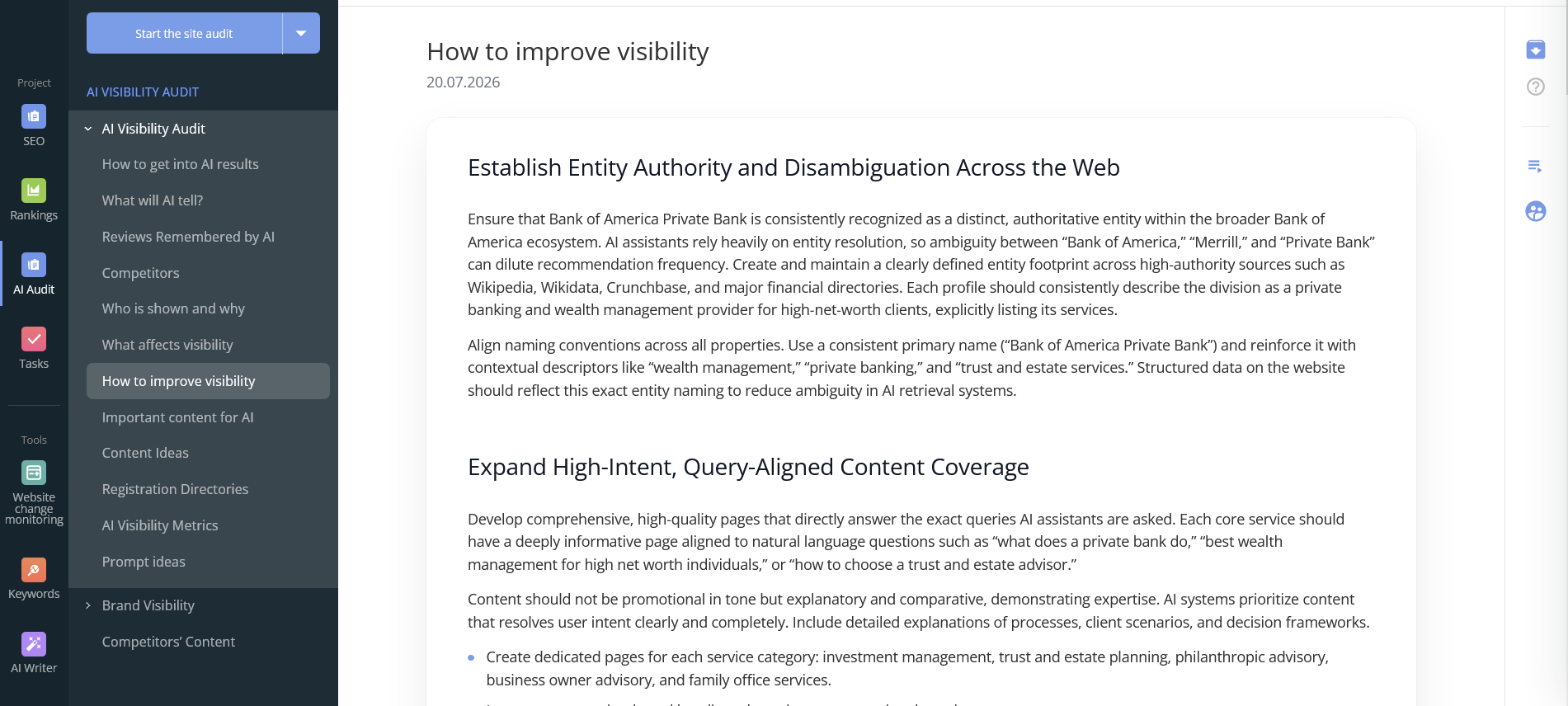
With the rise of conversational and search systems powered by artificial intelligence, traditional SEO metrics are no longer the sole compass. Today, ranking high in search results isn’t enough — what truly matters is that AI assistants consider your content reliable, easy to extract, and safe to cite. The report that inspired this article breaks down these changes in detail. It doesn’t just offer abstract advice; it provides a clear system of signals that modern AI models use to select sources. We won’t retell the document itself, but we’ll show why this kind of analysis is valuable and who benefits most from it.
What Makes This Report Stand Out: Key Strengths
The report’s greatest strength is its shift from positional thinking to semantic and structural optimisation. Instead of vague phrases like “write quality content,” it offers concrete, measurable signals: domain authority, brand mention frequency, structured data presence, and even site speed. The report excels because it:
- Explains the mechanics of how AI assistants choose sources at the Answer Extraction level.
- Provides ready‑to‑use content templates — the “question → brief answer → detail” block structure.
- Links traditional E‑E‑A‑T signals (Experience, Expertise, Authoritativeness, Trust) with new AI requirements.
- Shows how technical parameters (site structure, URL readability, speed) directly affect citation likelihood.
- Focuses on reputation management and external mentions, not just on‑page tweaks.
This approach gives a complete picture — from micro‑data markup to brand signals in the media. The report leaves no room for “grey” optimisation; every recommendation is backed by a practical implementation.
Valuable Insights You’ll Find in the Report
The document is packed with actionable knowledge that you can start using right away. Here are the core sections that make it a valuable asset for any web project:
- Principles of extractable content: how to craft headlines, answer‑style paragraphs, and avoid fluff so that AI can safely summarise your text.
- Strengthening E‑E‑A‑T through verifiable facts: adding expert pages, case studies with numbers, legal information, and links to external sources.
- Creating content for long‑tail conversational queries: examples of FAQs, use‑case scenarios, and real user questions.
- Off‑site brand signals: how publications on external platforms, reviews, and even unlinked mentions boost your chances of being recommended.
- Technical optimisation for AI: page speed, mobile‑friendliness, avoiding duplicate content, and logical internal linking.
- Structured data that matters: which schemas (FAQ, Organization, Product/Service) are critical for accurate information extraction.
- Relevance monitoring and competitor analysis: methods to check how AI already answers your target queries and adapt accordingly.
Special attention goes to sections on citability and differentiation. The report teaches you not just to be useful, but to become the go‑to source in your niche — with unique data, comparisons, and concrete details.
Who Will Benefit Most from This Report
Thanks to its universal structure and depth, the material suits a wide range of professionals. However, certain groups will find it a strategic roadmap:
- SEO specialists and optimisers: you’ll get a modern ranking methodology for the AI‑search era, learning to evaluate sites not by positions but by their suitability for assistant answers.
- Owners of expert and B2B websites: if your business relies on trust, authority, and complex information (healthcare, law, finance, IT services), the report shows how to build E‑E‑A‑T so that AI cites you.
- Marketers and content managers: you’ll discover how to create pages for real intents, format FAQs and case studies, and build brand signals through external platforms and social media.
- Product managers and online service owners: the report explains why technical quality and structured data directly influence AI recommendations — helping you set clear priorities for your development team.
- Agencies and freelancers offering SEO services: you’ll be able to offer clients a new type of audit — “AI visibility” — that considers not only search bots but also conversational systems.
The report is especially valuable for those who have already noticed traffic drops due to generative answers appearing in search results. It offers a path forward — not panic, but a strategic re‑engineering of your content for answer extraction and citability.
How to Apply the Report’s Findings in Practice
Modern SEO audit tools can help you automate many of the checks outlined in the report. You can set up structured data validation (checking for FAQ schema, Organization markup), evaluate page speed and mobile responsiveness, analyse internal linking, and identify duplicate content. Moreover, you can track brand mentions across the web and monitor backlink dynamics — precisely the off‑site brand signals that AI values. Use the report’s checklist as the foundation for a new audit module, and let automated platforms verify each point. This way, you turn theory into precise actions that boost your visibility in AI assistants.
Conclusion: Why You Should Implement These Recommendations Today
AI assistants are rapidly reshaping the search landscape. They already favour sources that are better structured, more authoritative, and easier to extract answers from. The report discussed here is not a collection of hypotheses — it’s a working model based on real signal analysis. Its main power lies in breaking the “ranking for ranking’s sake” paradigm and encouraging you to create content for both humans and AI simultaneously. Start small: review your pages for concise answer‑ready paragraphs, add FAQ markup, and compile case studies with numbers. Use the report as your roadmap — and your site will become the authoritative source that AI assistants recommend first.