
 English
expand_more
English
expand_more
 Español
 Deutsch
 Français
 Português
 Türkçe
 Polski
 العربية
 हिन्दी
Brand synonyms
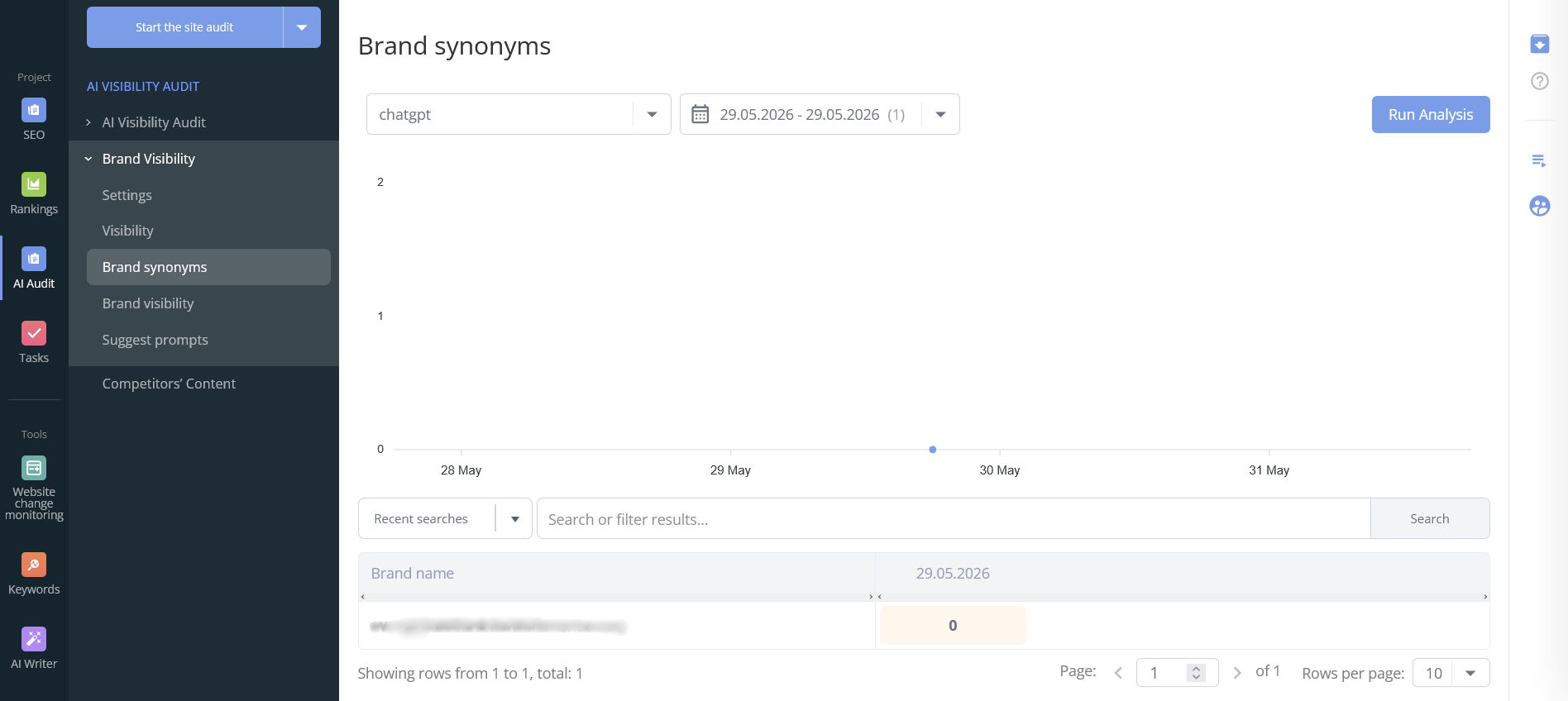
In today’s digital landscape, brands are rarely referred to by their formal, legal name. Users, journalists, and — most importantly — artificial intelligence (ChatGPT, Gemini, Claude, DeepSeek, and others) frequently employ synonyms, abbreviations, or informal variations. The Brand Synonym Report in our AI Visibility suite analyses your configured monitoring parameters (domain, name variants, and prompts) to reveal which alternative names actually appear in AI-generated responses. This is a vital tool for reputation control and fine‑tuning your mention strategy.
What the Brand Synonym Report Contains
The report automatically processes every AI‑visibility check you have run with your prompts, extracting every reference to your brand from the AI’s answers. It is structured into the following sections:
- List of detected synonyms — all alternative names the AI has used (e.g., “Apple” instead of “Apple Inc.”, “G” instead of “Google”, “Meta” for “Facebook”).
- Frequency of each synonym — the number of times a particular synonym appears in responses from selected AI assistants (ChatGPT, DeepSeek, Claude, etc.) across your prompts.
- Prompt association — each synonym is linked to the specific prompts that triggered it, helping you understand the context.
- Synonym trends over time — a chart or table showing how the set and frequency of synonyms evolve (daily or weekly).
- Comparison with your configured variants — the system highlights which of the alternative names you entered in settings are actually picked up by AI, and which are not. It also surfaces unexpected synonyms that you never specified but the AI uses anyway.
- Contextual snippets — extracts from AI responses where the synonym appears, with links to the full reply.
The report can be exported as CSV or PDF, and can be embedded into a regular monitoring dashboard.
Why Brand Synonym Analysis Matters
Many companies focus solely on their official domain or exact name, overlooking the millions of users and AI algorithms that rely on alternative forms. Tracking synonyms gives you several critical advantages:
- Complete reputational audit — if AI calls your brand by a wrong or distorted synonym, you can spot it early and take action (e.g., through feedback to model developers or by publishing clarifying content).
- SEO efficiency — synonyms frequently used in user queries to AI can expand your semantic core and inspire content tailored to actual voice search.
- Competitive intelligence — if your synonyms overlap with competitors’ names, the report reveals in which contexts the AI confuses brands — a signal to sharpen differentiating traits.
- Audience insight — what words do customers (and the AI trained on their texts) use to call you? The answer can guide your communication and advertising campaigns.
- PR effectiveness tracking — after launching a campaign to promote a new short brand version, the report shows whether AI has started adopting it.
Who Benefits from This Report
The tool is designed for professionals who manage digital presence and reputation:
- Brand managers and marketers — to monitor brand recognition in the new AI‑assistant channel and detect unwanted associations.
- SEO specialists — to enrich their keyword strategy with synonyms that actually generate mentions and potential traffic.
- Reputation managers (SERM) — to swiftly correct situations where AI uses an outdated or negatively charged brand name.
- PR teams and content creators — to evaluate the impact of press releases and publications: are AI models picking up your recommended name variants?
- Business owners and startup founders — to understand how their company is perceived beyond the official naming, especially when entering new markets.
- Legal departments — in cases where false synonyms could mislead or infringe trademarks (the report provides evidence).
The report becomes especially valuable once you have set up AI‑visibility monitoring (adding your domain, prompts, and a list of AI assistants). The Brand Synonym Report is the logical next step that turns raw data into actionable insights.
Practical Example
An online electronics retailer, “TechWorld”, with the domain techworld.com, configured its AI visibility with brand variants: “Tech World”, “TW”, and “TechWorld”. While analysing responses from ChatGPT and Claude for the prompt “where to buy a smartphone with fast delivery”, the system detected an unexpected synonym — “TWorld”. The report flagged it with 7 mentions over the past week. The marketing team realises they have never promoted that abbreviation, yet it is already in use. They can decide to legitimise “TWorld” and use it in ads, or try to replace it with their preferred version through publications and feedback to AI models. Without the report, this trend would have gone unnoticed.
How to Interpret the Data
Key metrics to pay attention to:
- Share of unexpected synonyms — the percentage of synonyms you did not specify in settings. A high share indicates that your brand has limited control over its reputation in natural language.
- Frequency trends — if a synonym spikes sharply in a short period, an external event (viral post, news) likely occurred. Investigate the context.
- Competitor synonyms — if your company is frequently mentioned alongside a distorted competitor name, that is a sign of brand confusion.
- Absence of your configured variants — if you entered an important name variant and the report does not find it, the AI is not using it — it may be unnatural or not yet widespread.
We recommend reviewing the Brand Synonym Report every 7‑14 days, especially after major PR activities or product changes. You can export the data and build your own analytics.
Conclusion
The Brand Synonym Report is not just an add‑on to your main AI‑visibility monitoring — it is a standalone tool that reveals how artificial intelligence (and the users who interact with it) actually communicates about your brand. By using this report, you can refine your naming, strengthen your SEO with the right keywords, protect your reputation from unwanted associations, and gain a competitive edge. Once you have configured your basic parameters (domain, name variants, prompts, AI list) in the AI Visibility section, the Brand Synonym Report will be generated automatically on a regular basis.