
 English
expand_more
English
expand_more
 Español
 Deutsch
 Français
 Português
 Türkçe
 Polski
 العربية
 हिन्दी
Important content for AI
With the rise of generative AI–powered search engines—such as SGE, ChatGPT, Perplexity, Bing AI, and others—traditional SEO metrics are no longer the only compass. Today, it is not enough to simply “please Google”; your content must be perceived as an authoritative source by artificial intelligence itself. To address this shift, modern SEO platforms now offer a dedicated AI Content Importance Report—a diagnostic tool that bridges classic optimization and the new AI‑driven landscape.
This report is generated automatically once the system has gathered sufficient data about a page or a website. It follows a standardised AI‑audit structure and serves as a roadmap for increasing your content’s citability in AI assistant responses. Below, we break down each section of the report, explain why it matters, and identify who benefits most from such an analysis.
1. Intent and Audience: What Problems the Content Solves and Who It’s For
The first section answers a fundamental yet often overlooked question: why does a user land on this page, and what specific need or interest does the content address? AI models are trained on behavioural patterns and semantics. If the page’s intent is vague, the neural network cannot confidently determine which queries should surface your material.
Why it matters: A clearly defined intent increases the likelihood that the AI will consider the page relevant to a given question. The report identifies intent types (informational, commercial, navigational, transactional) and the target audience based on tone, lexical complexity, and structure.
Who benefits: Content marketers, SEO professionals, and blog owners who want to appear in AI quick answers rather than just in traditional “blue‑link” results.
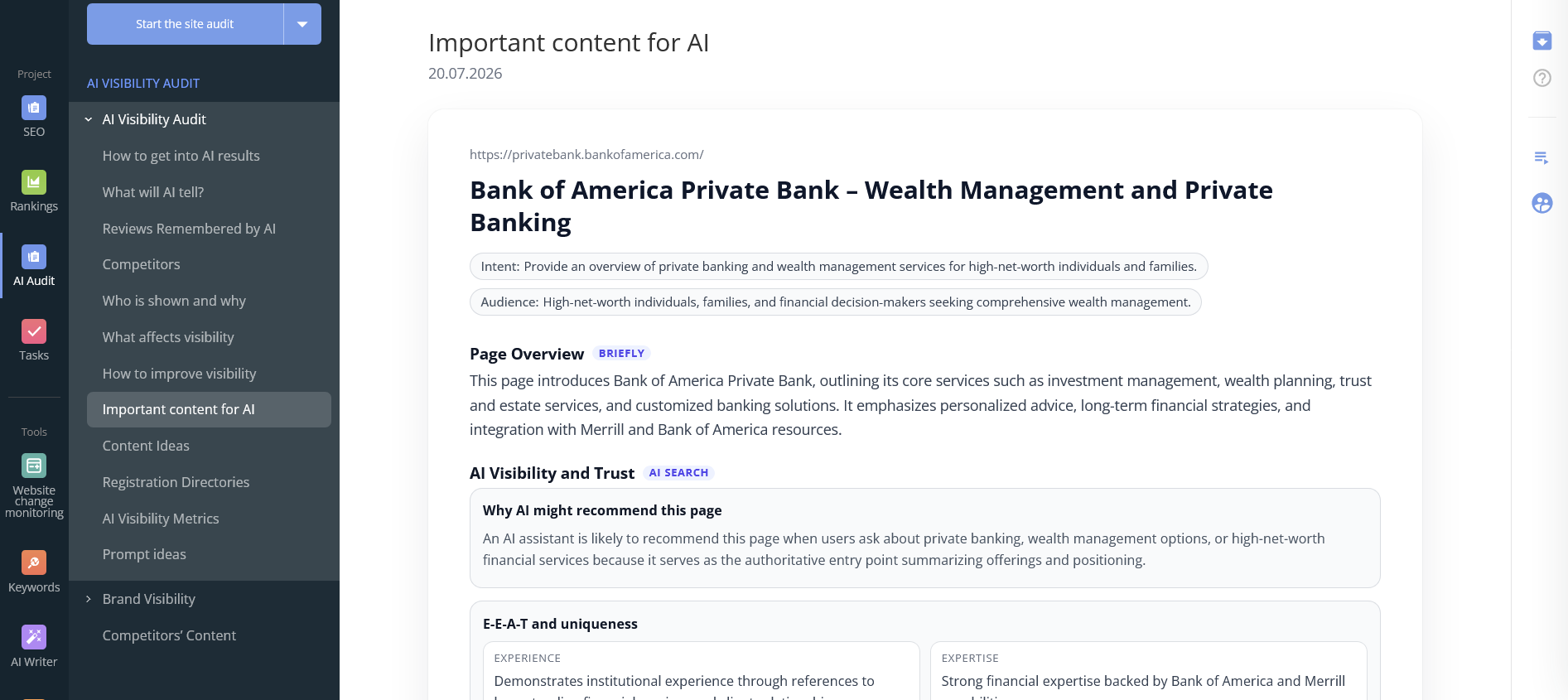
2. Brief Overview: Key Facts, Theses, and Positioning Through AI’s Eyes
This block simulates how a neural network “summarises” your page. It extracts the core facts, figures, arguments, and brand positioning that a large language model (LLM) would pick up. In essence, it tests whether your intended message aligns with what the AI considers most important.
Why it matters: If the AI highlights the wrong points (or misses your unique value proposition), your link may either not appear in generative answers or appear distorted. The report reveals the gap between your intended meaning and the model’s “read” of your content.
Who benefits: Copywriters, editors, and brand managers—anyone responsible for accurately conveying an expert standpoint.
3. Visibility in AI and Trust: Why AI Is Willing to Cite the Page
This is the most practical section. It analyses factors that influence an AI assistant’s decision to quote or recommend a page: backlinks from reputable sources, citations in academic or industry publications, page speed, structured data, update frequency, and even the “domain reputation” as perceived by LLMs.
Why it matters: AI doesn’t just rank relevance—it evaluates trust. A page may perfectly answer a question, but without trust signals, the AI will prefer a more citable source. The report shows which trust signals you already have and which need to be built.
Who benefits: SEO strategists, link‑building specialists, and PR teams responsible for online reputation.
4. E‑E‑A‑T and Uniqueness: Experience, Expertise, Authoritativeness, and Trustworthiness
The E‑E‑A‑T framework (Experience, Expertise, Authoritativeness, Trustworthiness) is the cornerstone of quality evaluation—not only for Google but also for modern AI systems. The report scans your page for evidence of real‑world experience (case studies, practical examples), expertise (deep knowledge, absence of errors), authoritativeness (mentions, awards, author bios), and trustworthiness (transparency, contact information, privacy policy).
Why it matters: AI models are trained to avoid unreliable sources. If your page lacks proof of expertise (e.g., a medical article without the author’s medical credentials), the AI will not recommend it—even if the text is flawless. The report shows which E‑E‑A‑T signals are already visible and which need urgent reinforcement.
Who benefits: Websites in YMYL niches (health, finance, law, wellness), e‑commerce sites with product reviews, and educational portals.
5. Weaknesses and Risks: Competitor Substitution and Misinterpretations
An honest diagnosis. This section warns where meaning is insufficiently supported by facts, where contradictions may arise (e.g., your page claims one thing, while other authoritative sources claim another). It also identifies risks of competitor substitution: if your key points are weakly anchored, the AI may take a similar answer from a competitor’s site that has higher trust or better structure.
Why it matters: Weak spots are leaks in your AI‑driven traffic. Knowing them allows you to perform targeted optimisation rather than rewriting the entire site. Moreover, the report helps prevent misinterpretation—for example, when the AI attributes an opinion to you that you do not hold.
Who benefits: Product managers, analysts, and site owners who are losing ground in SGE and cannot pinpoint the cause.
6. Action Plan: Specific Improvements to Boost Citability
The final—and most valuable—section. The report does not just criticise; it provides a ready‑to‑use checklist of improvements: how to restructure content, add missing trust signals, enhance uniqueness, resolve contradictions, and implement FAQs or tables for better fact extraction. The plan is prioritised—from quick wins to long‑term strategic tasks.
Why it matters: Without action, the report remains just a diagnosis. The action plan enables your team to start increasing visibility in AI assistants immediately, saving weeks of trial and error.
Who benefits: Project managers, marketing team leads, SEO departments, and business owners who want measurable results.
Who Needs This Report Most?
- High‑volume content sites (blogs, news media, online magazines) — to protect traffic after SGE rollout.
- E‑commerce projects — product and category pages are increasingly featured in generative answers, especially in comparisons.
- Expert and educational resources — they have a natural advantage in E‑E‑A‑T, but they need to “communicate” it properly to AI.
- YMYL websites — where the cost of error is high and AI trust is critical for lead generation.
- SEO agencies and freelancers — to justify new AI‑optimisation directions to clients.
How to Obtain Such a Report
AI Content Importance Reports are typically available within advanced SEO platforms that offer AI auditing modules. After adding your project and allowing data collection (usually 7 to 30 days, depending on site activity), the system generates a visual HTML table with colour‑coded indicators (green = good, yellow = moderate, red = risk). Some tools also allow on‑demand checks for individual URLs.
Important: This report is not a one‑off exercise. AI models are constantly updated, so it is recommended to rerun the audit every 1‑2 months or after major content changes.
To summarise: The AI Content Importance Report is the bridge between classical SEO and the generative search era. It answers three pivotal questions: Does AI see me? Does it trust me? And what must I do to be recommended more often? Use it to stay visible while your competitors are still figuring out the new reality.
Key takeaway: In the age of AI‑driven search, authoritative content is not just about keywords—it’s about intent, trust, and clear signals of expertise. The AI Content Importance Report gives you a data‑driven roadmap to achieve exactly that.